


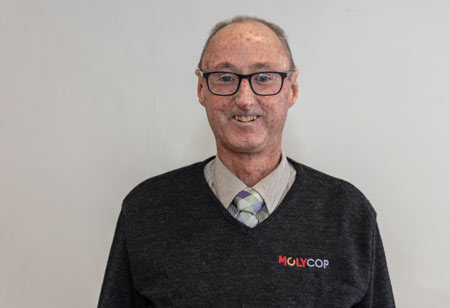
Dr. Paul Shelley
Dr Shelley is currently the Vice President of Innovation at Molycop. Dr. Shelley has a Diploma in Mechanical Engineering and is a Manufacturing/Materials engineer, graduating with honours from the University of Queensland. He holds an MBA, majoring in technology management and a DBA in the field of organisational behavior from Deakin University. Additionally, he has 40 years of experience in the mining sector.
The most significant industry changes originate from the world’s leading mining companies formally committing themselves to net zero scope 3 carbon emissions by at least 2050. In this article, Dr. Paul Shelley highlights how the energy footprint of the semi-autogenous grinding (SAG) mill is in sharp focus and is driving rethinking in circuit efficiency, equipment and design. The resulting initiatives will change SAG milling in the immediate future.
The digital transformation
Innovation and Digital Transformation (DT) have emerged as critical players to solve the industry’s challenges. The engine for deploying innovation and DT lies not with the miners themselves but with the supplier base. This is because the industry's history can be summarised as a conservative industry, favouring incremental improvement to step change. It is an industry that relies on suppliers, large and small, for its innovation. The technology embedded in machinery, services and other inputs allows for innovation to occur in this sector. The current trend is sensor-based monitoring of the process chain including the grinding processes. Value propositions are maturing that show how digital platforms use advanced statistical techniques, artificial intelligence and machine-learning algorithms to predict SAG mill operating states in real-time. These systems have a profound influence on operations now and are changing the way miners think about milling in the near term. This includes rethinking the circuit plant and equipment.
Product development
The thirst for energy efficiency and embracing digital transformation is advancing equipment design and thinking. It is proposed that high-pressure grinding rolls (HPGR) are a significant part of the solution to reducing the carbon footprint of mineral processing. Morrell states that HPGR deployment has the potential to reduce the mining industry’s carbon dioxide (CO2) emissions by up to 34.5 mega-tonnes/year or 43.5 percent when compared to the established autogenous (AG)/SAG ball mill circuit alternatives.
Powell proposes the AG mill could make a comeback driven by the benefit of removing the hidden footprint of embodied energy and CO2 emissions of steel grinding media. The Canadian Mining Innovation Council presents a completely new comminution machine, the conjugate anvil hammer mill (CAHM) which is positioned to revolutionise energy consumption in comminution. The BHP West Musgrave project deliberately excluded SAG milling. The processing plant has two stages of crushing, followed by two parallel vertical roller mills.
“The technology embedded in machinery, services and other inputs allows for innovation to occur in this sector. The current trend is sensor-based monitoring of the process chain including the grinding processes”
As alternatives for the SAG mill, practitioners evaluate upstream plants and equipment influencing the operation. For example, large-scale ore sorting is a developing field. Ore sorting success stories across several large mining companies including Anglo American, Teck Resources, Xintianling Wolfram Mine and many lower-tier companies such as EQ Resources. These circuit changes will influence SAG mill consumables.
The liners and grinding media undergo continuous wear, which negatively impacts the mill efficiency and necessitates periodic replacement. Developing more durable materials for mill liners and grinding media is a significant trend.
It is reasonable to conclude that these types of product development will significantly change the operation of the SAG mill if they do not entirely replace it.
Catalysts of change in the industry ahead
The immediate future of the SAG mill is one of change. Historically the industry leaders are conservative and change is slow but the urgent need for energy and water efficiencies may accelerate change. Miners must play their role via technology deployment and in-field trials. Most likely the changes will be:
• Driven by the digital transformation and influence of SAG mill operation and operating paradigms. This seems particularly so in mill monitoring, data analytics, process control and virtual machines.
• Modifications to the existing deployed fleet rather than wholesale replacement.
• Very largely influenced by the validation of emerging equipment like CAHM, HPGR, ore sorting and fragmentation. The validation speed depends on the miner’s appetite for in-field trials and initial circuit disruption.
• Customisation. Given the variability in ore properties across different mining sites, there is a growing need for SAG mills that can be customized and are flexible in operations. This results in the milling operation efficiently handling ore with varying properties without extensive reconfiguration or downtime. Customisation will also apply to the SAG consumables where innovative designs aim to improve the efficiency of the grinding process, reducing downtime and the frequency of liner replacements.
• Numerous. One can expect incremental, step change and disruption emerging from supplier initiatives. Possibly, a step change is most likely.
• Based on the increasing visibility and homogeneity of the feed ore. Variability is the villain.
